About Me

Dawood Wasif

PhD Researcher at Virginia Tech

I am a second-year Computer Science PhD student at Virginia Tech, working in the Trustworthy Cyberspace Lab. My research addresses a core challenge in modern machine learning: how to build systems that are simultaneously private, fair, and high-performing when deployed in safety-critical environments. I develop principled methods at the intersection of federated learning, human-in-the-loop reinforcement learning, and multi-agent LLM systems. On the applied side, I design and evaluate these frameworks in domains where failures carry real consequences: autonomous vehicles, UAV/UGV swarm coordination, and cloud infrastructure automation.

I have had the opportunity to learn from and work alongside outstanding researchers, such as Dr. Jin-Hee Cho, Dr. Chang-Tien Lu, Dr. Chandan K. Reddy, and Dr. Terrence J. Moore. My recent work has been accepted at top venues including ICML, ICLR, AAAI/ACM AIES, and FAccT. Beyond research, I completed my summer internship with iD Tech @ Amazon HQ2 (Arlington) in Summer 2025, and I will join Rivian in Summer 2026 as a Motor Controls Machine Learning Intern.

Prior to Virginia Tech, I held a DAAD Research Fellowship at the Technical University of Munich (TUM), where I worked on uncertainty quantification for remote sensing under Prof. Xiaoxiang Zhu. I received my BS in Computer Science from NUST, Pakistan.

Dawood Wasif
9+
Publications
4
Top-Tier Venues
4
Invited Talks
6+
Reviewer Roles

Latest News

Recent papers, talks, publications, and research milestones
May 2026
MILESTONE Started as a Motor Controls Machine Learning Engineering Intern at Rivian in Carson, CA.
May 2026
PAPER "Explainable Federated Learning via Global-Local Attribution Alignment" was accepted at ICML 2026.
Apr 2026
PAPER "Toward Individual Fairness Without Centralized Data: Selective Counterfactual Consistency for Vertical Federated Learning" was accepted at ACM FAccT 2026.
Apr 2026
PAPER Two papers were accepted at USENIX VehicleSec 2026: "SHIELD: Secure Human-Machine Interaction with Evidential Learning and Dynamic Trust for Drone Swarm Control" and "Risk-Aware Human-in-the-Loop Framework with Adaptive Intrusion Response for Autonomous Vehicles".
Mar 2026
TALK Delivered a research talk at ACM CAPWIC 2026 on responsible AI and trustworthy machine learning systems at Virginia Tech, Innovation Campus in Alexandria, Virginia.
Feb 2026
PAPER "RESFL: An Uncertainty-Aware Framework for Responsible Federated Learning by Balancing Privacy, Fairness and Utility" was accepted at ICLR 2026.
Jan 2026
MILESTONE PhD Qualifier exam was waived and passed — advancing to doctoral dissertation research.
Jan 2026
TALK Delivered an invited talk on "Human-in-the-Loop for Shared and Secure Autonomy" at the U.S. Army Research Laboratory in Adelphi, Maryland.
Oct 2025
PAPER Presented "Empirical Analysis of Privacy-Fairness-Accuracy Trade-offs in Federated Learning" at AAAI/ACM AIES 2025 in Madrid, Spain.
Sep 2025
TALK Presented a research talk on "Towards Trustworthy AVs: Semantic-Guided and Risk-Aware Learning" at the NSF AI Awareness Workshop at Virginia Tech.
Jul 2025
PAPER "Empirical Analysis of Privacy-Fairness-Accuracy Trade-offs in Federated Learning" was accepted at AAAI/ACM AIES 2025.
Jun 2024
PAPER Released "How Certain Are Uncertainty Estimates? A Benchmark and New Evaluation Framework for Earth Observation Semantic Segmentation" in collaboration with Technical University of Munich and the University of Bristol, now available on arXiv.
Jul 2023
TALK Presented "Towards a Benchmark EO Semantic Segmentation Dataset for Uncertainty Quantification" at IEEE IGARSS 2023 in Pasadena, California, USA.
Dec 2022
MILESTONE Completed a DAAD Research Fellowship at the Technical University of Munich (TUM) under the Chair of Data Science in Earth Observation.
Oct 2022
TALK Presented "Extraction of Rice Phenological Metrics Using Temporally Correlated Multispectral Drone Imagery" at IEEE SITIS 2022 in Dijon, France.

Publications

My research investigates how to build ML systems that are simultaneously private, fair, and performant. I focus on federated learning, human-in-the-loop RL, and multi-agent architectures, with deployments in autonomous driving, drone swarms, and cloud infrastructure.

2026
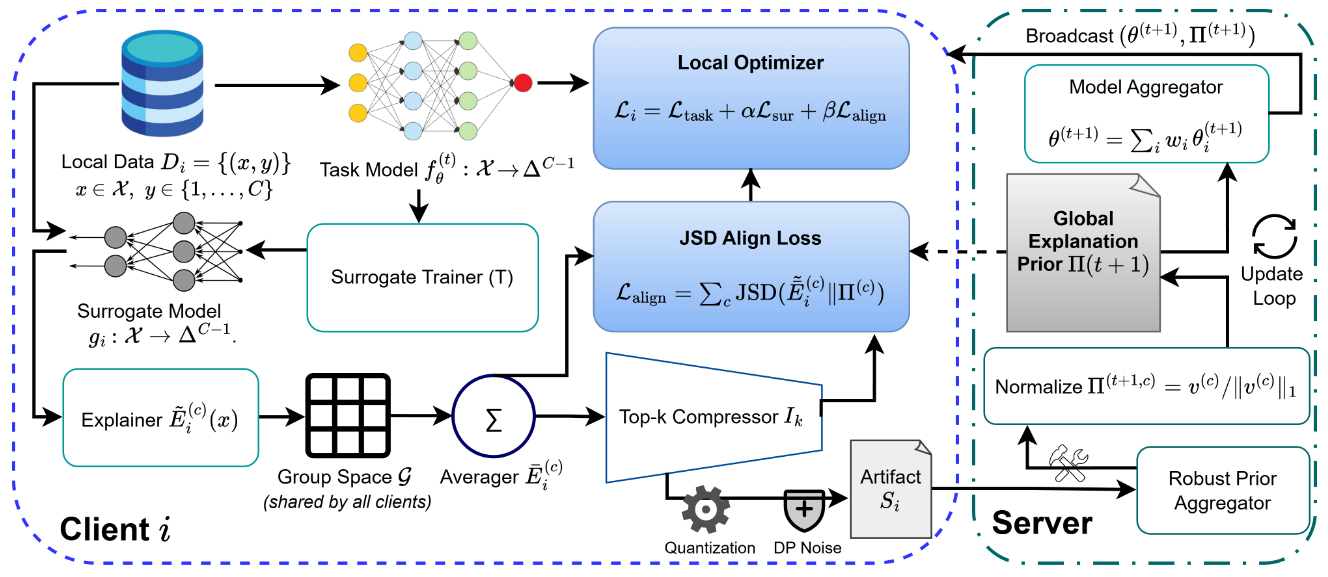
XFL Architecture
ICML 2026
Aligning global and local attribution maps for interpretable federated models without compromising privacy or utility.
Website Paper Code
Federated learning enables on-device training without centralizing data, yet existing systems still struggle to provide explanations that are both locally faithful and globally consistent under strict privacy and bandwidth constraints. Prior approaches either keep explanations siloed across clients, transmit heavy or sensitive artifacts, or replace expressive task models with interpretable surrogates that sacrifice accuracy. We propose xFedAlign, a model-agnostic framework that decouples task optimization in parameter space from explanation coordination in a compact group space. Each client distills a lightweight surrogate to produce private, per-class top-k attribution artifacts, which are robustly aggregated by the server into a Global Explanation Prior that softly aligns client explanations without constraining task learning. Across image, text, and tabular benchmarks with IID and non-IID partitions, xFedAlign matches FedAvg accuracy while consistently reducing explanation drift and improving deletion and insertion AUC relative to Local-XAI, FedAttr-Agg, and Fed-XAI, with only a few kilobytes of additional communication per round. Privacy and robustness evaluations further demonstrate reduced membership inference advantage and increased resistance to attribution poisoning, enabling consistent and trustworthy explanations in federated learning.
@inproceedings{wasif2026xfedalign,
  title={Explainable Federated Learning via Global--Local Attribution Alignment},
  author={Wasif, Dawood and Moore, Terrence J. and Lu, Chang-Tien and Cho, Jin-Hee},
  booktitle={Proceedings of the International Conference on Machine Learning},
  year={2026},
  url={https://openreview.net/forum?id=gicCGXeG2P}
}
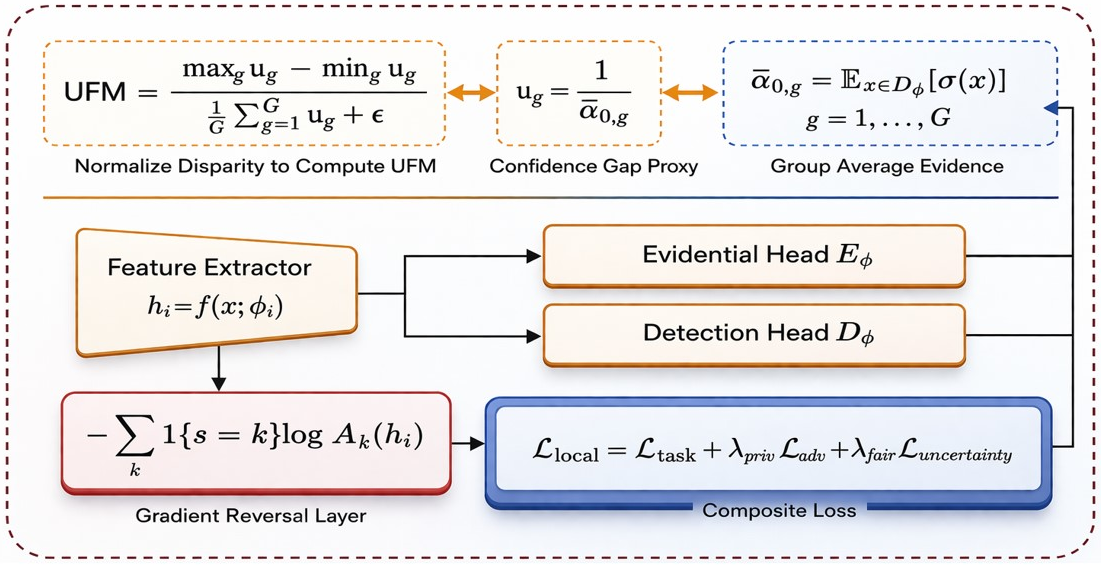
RESFL Framework
ICLR 2026
Jointly optimizing privacy, fairness, and accuracy in federated settings for autonomous vehicles using uncertainty-driven objectives.
Website Paper Code
Federated Learning (FL) has gained prominence in machine learning applications across critical domains, offering collaborative model training without centralized data aggregation. However, FL frameworks that protect privacy often sacrifice fairness and reliability; differential privacy reduces data leakage but hides sensitive attributes needed for bias correction, worsening performance gaps across demographic groups. This work explores the trade-off between privacy and fairness in FL-based object detection and introduces RESFL, an integrated solution optimizing both. RESFL incorporates adversarial privacy disentanglement and uncertainty-guided fairness-aware aggregation. The adversarial component uses a gradient reversal layer to remove sensitive attributes, reducing privacy risks while maintaining fairness. The uncertainty-aware aggregation employs an evidential neural network to weight client updates adaptively, prioritizing contributions with lower fairness disparities and higher confidence. This ensures robust and equitable FL model updates. We demonstrate the effectiveness of RESFL in high-stakes autonomous vehicle scenarios, where it achieves high mAP on FACET and CARLA, reduces membership-inference attack success by 37%, reduces equality-of-opportunity gap by 17% relative to the FedAvg baseline, and maintains superior adversarial robustness. However, RESFL is inherently domain-agnostic and thus applicable to a broad range of application domains beyond autonomous driving.
@inproceedings{wasif2026resfl,
  title={RESFL: An Uncertainty-Aware Framework for Responsible Federated Learning by Balancing Privacy, Fairness and Utility},
  author={Wasif, Dawood and Moore, Terrence J. and Cho, Jin-Hee},
  booktitle={International Conference on Learning Representations},
  year={2026},
  url={https://arxiv.org/abs/2503.16251}
}
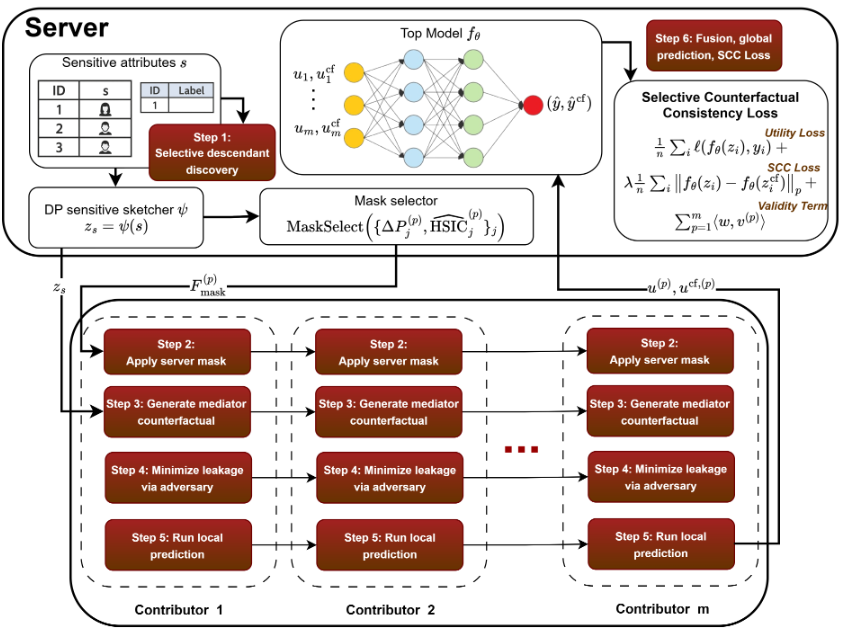
Fairness FL
ACM FAccT 2026
Counterfactual-based individual fairness enforcement in vertical FL without centralized access to sensitive features.
Website Paper Code
When algorithmic decisions depend on data distributed across institutions, how can we ensure that an individual’s outcome does not change arbitrarily based on a protected attribute? We study this question in vertical federated learning (VFL), where features are split across parties, sensitive attributes may be private, and proxies for protected characteristics can be scattered across institutional boundaries under strict privacy constraints. Our focus is on individual-level counterfactual stability, i.e., per-instance prediction consistency under protected-attribute interventions as formalized in the causal fairness literature, rather than group parity guarantees such as demographic parity or equalized odds. We propose SCC-VFL, a server-centric framework for enforcing selective counterfactual consistency (SCC) at the individual level in VFL. SCC-VFL operationalizes a given policy specification by combining three components: (i) differentially private, graph-free discovery of feature roles into non-descendants, policy-permitted mediators, and impermissible proxies using only a formally private sketch of the sensitive attribute, with a formal per-release privacy that does not extend to the full training pipeline; (ii) masked counterfactual generation that edits only mediators while fixing non-descendants and suppressing proxy leakage; and (iii) server-side enforcement via an SCC consistency loss that penalizes impermissible prediction changes under protected-attribute interventions. Across three real-world datasets spanning credit, healthcare, and criminal justice, SCC-VFL maintains or improves predictive accuracy while sharply reducing decision flip rates by up to 98% relative to strong baselines. It also lowers attribute-inference attack success and improves robustness, demonstrating favorable utility-fairness-privacy trade-offs in realistic VFL deployments.
@inproceedings{wasif2026scc,
  title={Toward Individual Fairness Without Centralized Data: Selective Counterfactual Consistency for Vertical Federated Learning},
  author={Wasif, Dawood and Reddy, Chandan K. and Moore, Terrence J. and Cho, Jin-Hee},
  booktitle={Proceedings of the ACM Conference on Fairness, Accountability, and Transparency},
  year={2026},
  url={https://openreview.net/forum?id=OjD3qbcRwr}
}
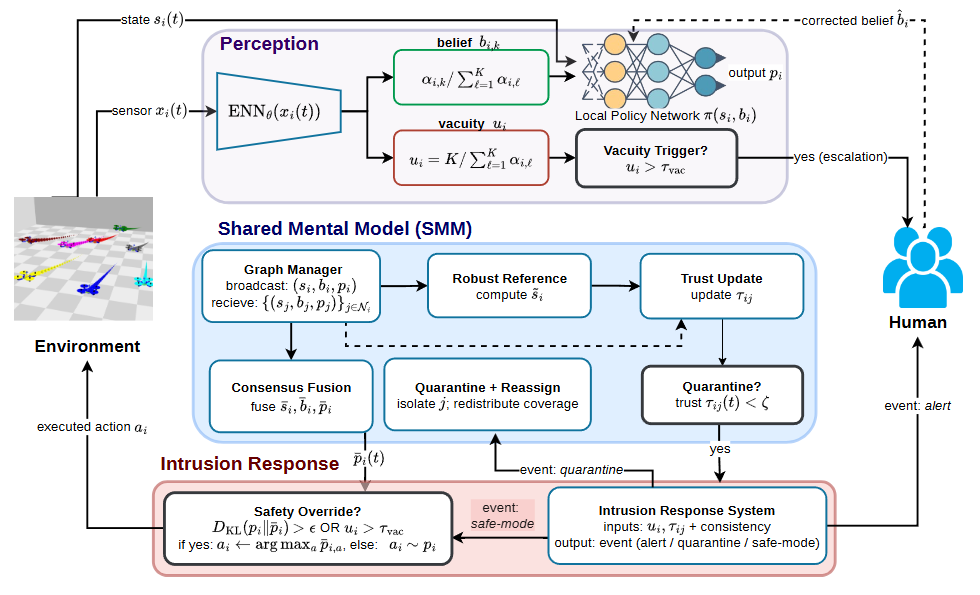
SHIELD Framework
USENIX VehicleSec 2026
Trust-calibrated human-machine teaming in multi-drone operations via evidential deep learning.
Website Paper Code
Coordinated drone swarms offer transformative capabilities in defense, surveillance, and disaster response but pose core AI alignment challenges: ensuring safe, corrigible, and robust behavior under uncertainty and adversarial threat. Existing human-in-the-loop and shared-autonomy approaches often rely on fixed trust models or centralized overrides, lack principled mechanisms for uncertainty estimation, and fail to scale securely. We present SHIELD, a unified framework for secure, scalable human–swarm teaming that integrates: (i) evidential deep learning to quantify epistemic uncertainty via vacuity scores; (ii) a dynamic trust graph that filters compromised agents through behavior-based trust propagation; and (iii) a lightweight intrusion response system for real-time attack detection, quarantine, and recovery. Human oversight is triggered only when agents encounter unfamiliar inputs or consensus breaks down, minimizing cognitive load. In high-fidelity simulations, SHIELD reduces collision penalties by 10%, improves mission completion by 25%, and detects over 80% of GPS spoofing, jamming, and replay attacks while halving human interventions. Ablation studies confirm each module’s importance, and scalability experiments show graceful performance degradation from 8 to 32 agents and increasing obstacle density. Our findings demonstrate that SHIELD’s integration of uncertainty, trust, and embedded defense offers a principled and practical solution to real-world alignment in multi-agent autonomous systems.
@inproceedings{wasif2026shield,
  title={SHIELD: Secure Human-Machine Interaction with Evidential Learning and Dynamic Trust for Drone Swarm Control},
  author={Wasif, Dawood and Moore, Terrence J. and Yoon, Seunghyun and Lim, Hyuk and Kim, Dan and Nelson, Frederica F. and Cho, Jin-Hee},
  booktitle={Proceedings of the USENIX Workshop on Autonomous Systems Security},
  year={2026},
  url={https://arxiv.org/pdf/2605.07117v1}
}
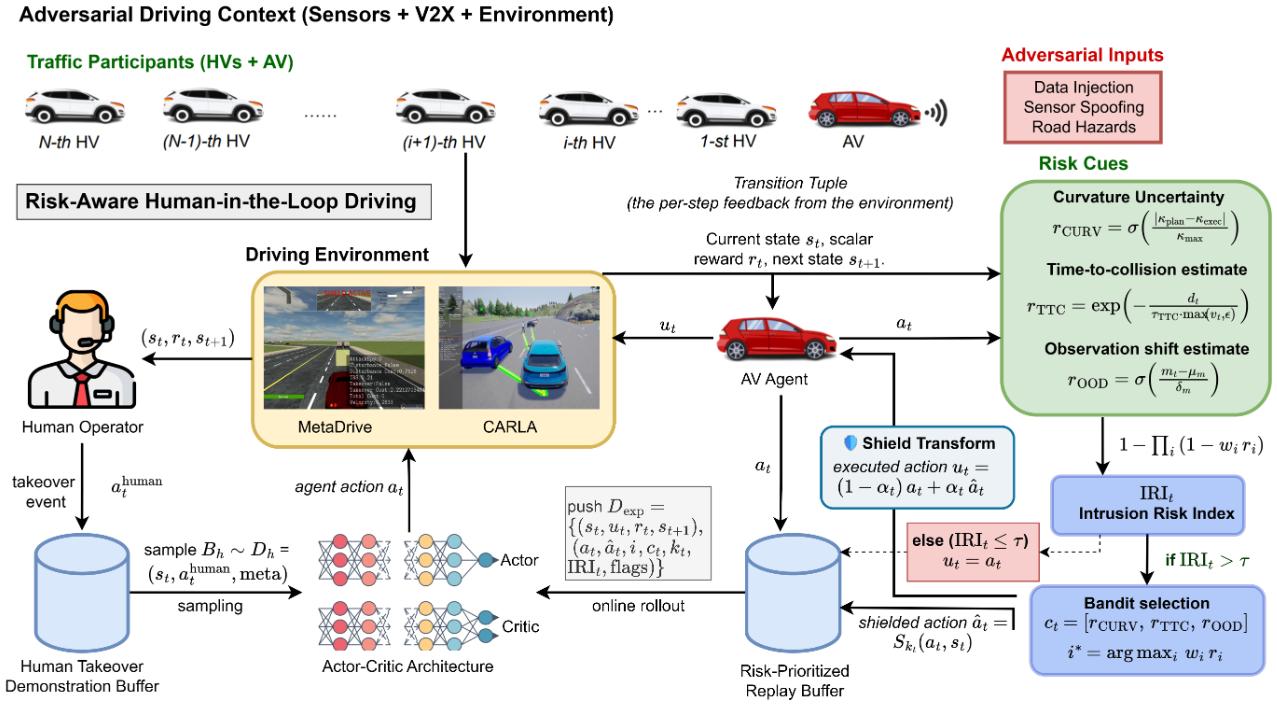
Risk-Aware Framework
USENIX VehicleSec 2026
Dynamic autonomy adjustment based on threat assessment and driver trust in AV scenarios.
Website Paper Code
Autonomous vehicles must remain safe and effective when encountering rare long-tailed scenarios or cyber–physical intrusions during driving. We propose a risk-aware human-in-the-loop framework, RAIL, that explicitly closes the detect–respond–learn loop within a unified runtime architecture. RAIL introduces an interpretable Intrusion Risk Index (IRI) that fuses heterogeneous runtime cues, including curvature actuation integrity, time-to-collision proximity, and observation-shift consistency, through a weighted Noisy-OR to enable probabilistic, source-decomposed risk quantification at control rate. When risk rises, a contextual bandit selects cue-specific shields and a graded authority blending mechanism interpolates between nominal and safeguarded actions, preserving efficiency under low risk while enabling proactive containment under threat. RAIL further integrates dual reward shaping and risk-prioritized replay so that takeovers and near misses steer learning. Across MetaDrive and CARLA, RAIL matches expert-level success while reducing safety violations and operator interventions relative to RL, safe RL, offline and imitation baselines. Under Controller Area Network (CAN) injection and LiDAR spoofing, RAIL reduces attack success rates by up to 48% and lowers disengagement under attack by more than 50%, demonstrating that explicit multi-source risk modeling yields substantial robustness gains in safety-critical autonomy.
@inproceedings{wasif2026rail,
  title={Risk-Aware Human-in-the-Loop Framework with Adaptive Intrusion Response for Autonomous Vehicles},
  author={Wasif, Dawood and Moore, Terrence J. and Yoon, Seunghyun and Lim, Hyuk and Kim, Dan and Nelson, Frederica F. and Cho, Jin-Hee},
  booktitle={Proceedings of the USENIX Workshop on Autonomous Systems Security},
  year={2026}
}
IaC Generation
CLOUD COMPUTING 2026
Automated, policy-compliant IaC generation with self-verification via multi-agent LLM pipelines.
Website Paper Code
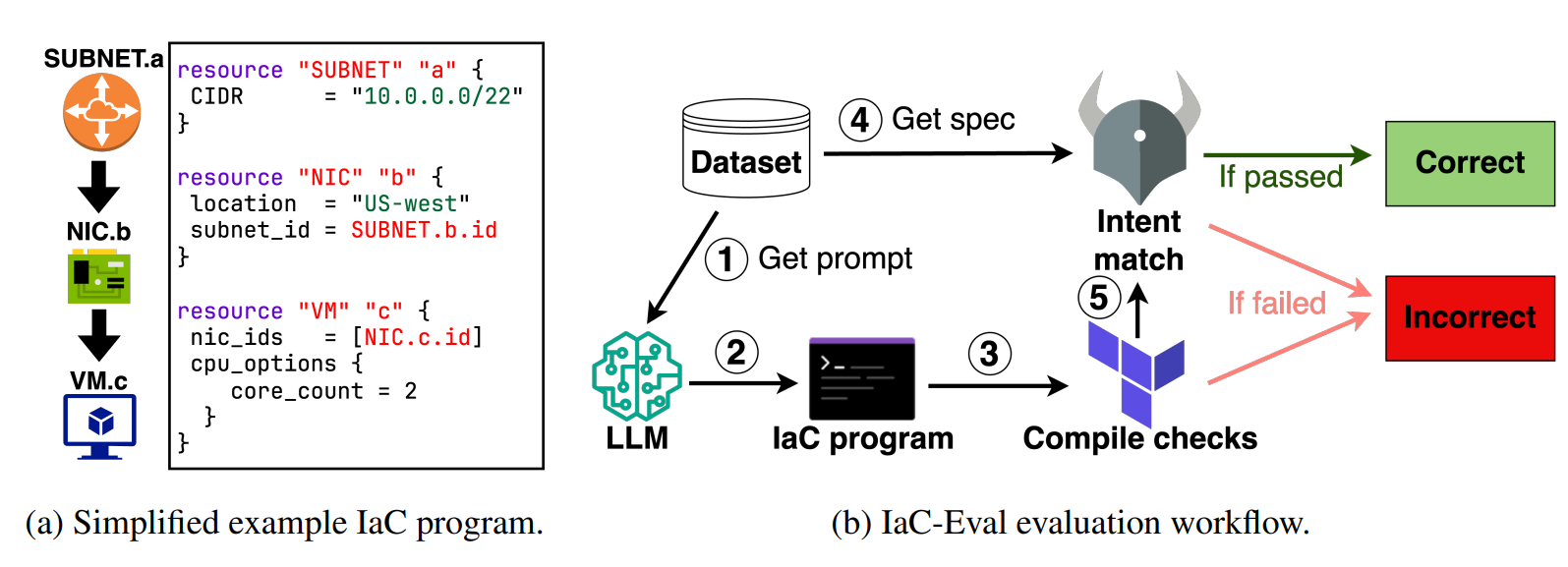
The increasing complexity of cloud-native infrastructure has made Infrastructure-as-Code (IaC) essential for reproducible and scalable deployments. While large language models (LLMs) have shown promise in generating IaC snippets from natural language prompts, their monolithic, single-pass generation approach often results in syntactic errors, policy violations, and unscalable designs. In this paper, we propose MACOG (Multi-Agent Code-Orchestrated Generation), a novel multi-agent LLM-based architecture for IaC generation that decomposes the task into modular subtasks handled by specialized agents: Architect, Provider Harmonizer, Engineer, Reviewer, Security Prover, Cost and Capacity Planner, DevOps, and Memory Curator. The agents interact via a shared-blackboard, finite-state orchestrator layer, and collectively produce Terraform configurations that are not only syntactically valid but also policy-compliant and semantically coherent. To ensure infrastructure correctness and governance, we incorporate Terraform Plan for execution validation and Open Policy Agent (OPA) for customizable policy enforcement. We evaluate MACOG using the IaC-Eval benchmark, where MACOG is the top enhancement across models, e.g., GPT-5 improves from 54.90 (RAG) to 74.02 and Gemini-2.5 Pro from 43.56 to 60.13, with concurrent gains on BLEU, CodeBERTScore, and an LLM-judge metric. Ablations show constrained decoding and deploy feedback are critical: removing them drops IaC-Eval to 64.89 and 56.93, respectively.
@inproceedings{wasif2026macog,
  title={Multi-Agent Code-Orchestrated Generation for Reliable Infrastructure-as-Code},
  author={Khan, Rana Nameer Hussain and Wasif, Dawood and Cho, Jin-Hee and Butt, Ali R.},
  booktitle={Proceedings of the Cloud Computing Conference},
  year={2026}
}
2025
FL Architecture
AAAI/ACM AIES 2025
Systematic study of context-dependent privacy-fairness-accuracy trade-offs in federated learning systems.
Website Paper Code
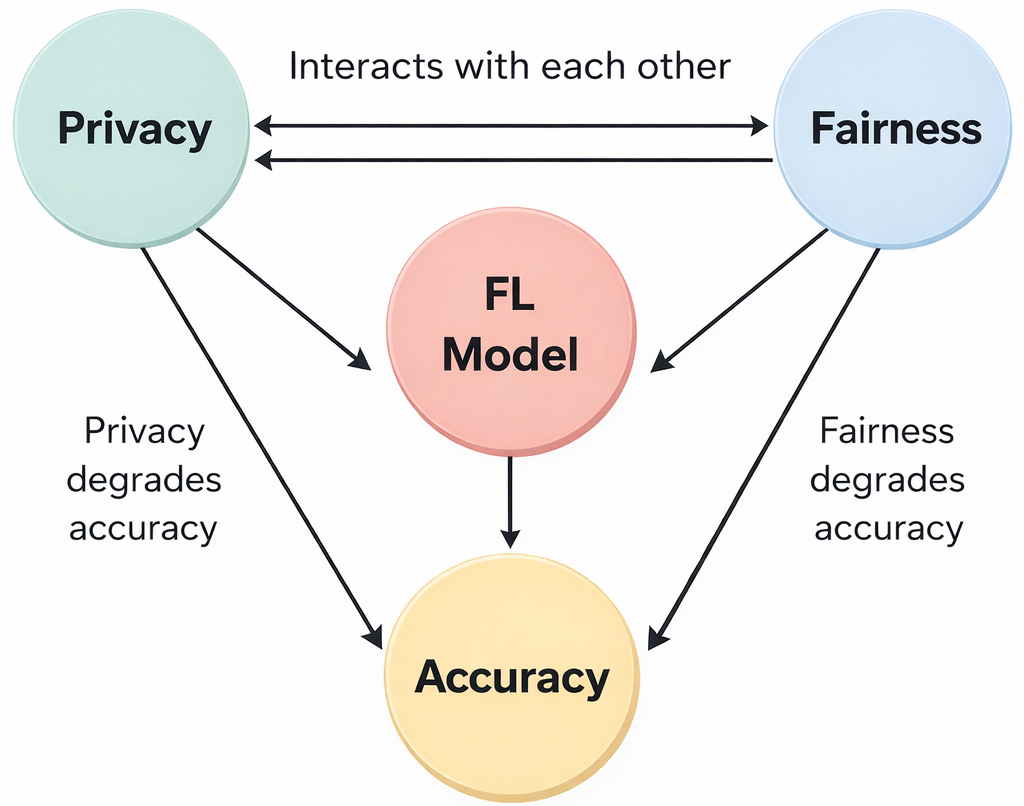
Federated Learning (FL) enables collaborative model training while preserving data privacy; however, balancing privacy preservation (PP) and fairness poses significant challenges. In this paper, we present the first unified large-scale empirical study of privacy-fairness-utility trade-offs in FL, advancing toward responsible AI deployment. Specifically, we systematically compare Differential Privacy (DP), Homomorphic Encryption (HE), and Secure Multi-Party Computation (SMC) with fairness-aware optimizers including q-FedAvg, q-MAML, Ditto, evaluating their performance under IID and non-IID scenarios using benchmark (MNIST, Fashion-MNIST) and real-world datasets (Alzheimer's MRI, credit-card fraud detection). Our analysis reveals HE and SMC significantly outperform DP in achieving equitable outcomes under data skew, although at higher computational costs. Remarkably, we uncover unexpected interactions: DP mechanisms can negatively impact fairness, and fairness-aware optimizers can inadvertently reduce privacy effectiveness. We conclude with practical guidelines for designing robust FL systems that deliver equitable, privacy-preserving, and accurate outcomes.
@inproceedings{wasif2025privacyfairness,
  title={Empirical Analysis of Privacy--Fairness--Accuracy Trade-offs in Federated Learning},
  author={Wasif, Dawood and Chen, Dian and Madabushi, Sindhuja and Alluru, Nithin and Moore, Terrence J. and Cho, Jin-Hee},
  booktitle={AAAI/ACM Conference on AI, Ethics, and Society},
  year={2025},
  doi={10.1609/aies.v8i3.36746}
}
2023
Berlin dataset
IEEE IGARSS 2023
Synthetic dataset from 3D mesh models for benchmarking semantic segmentation and uncertainty quantification.
Website Paper Code
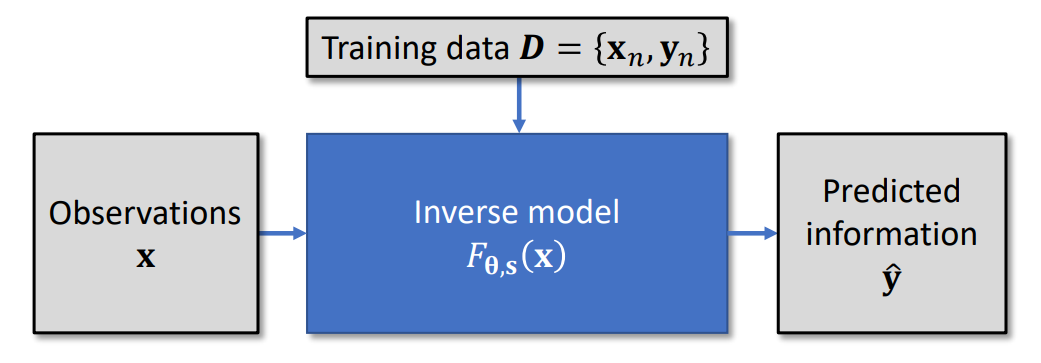
In order to achieve the objective of accurate and reliable use of deep neural networks for Earth Observation in large-scale scene understanding and interpretation, a large and diverse dataset with proper quantification of uncertainty is required. In this work, we exemplify the lack of a benchmark dataset and present the progress of a novel benchmark dataset for uncertainty quantification of deep learning models in the classic problem of building segmentation from overhead imagery. We present a synthetic dataset where synthetic UAV images were rendered from 3D mesh models of Berlin, Germany. The building masks were extracted from precise LoD-2 building models of the same area. We compare and contrast the performances of baseline methods for semantic segmentation and various uncertainty quantification techniques on this dataset. The experiments show that U-Net is the most accurate model with mIoU of 0.812. Moreover, the Bayesian model is found to be the most reliable uncertainty quantification method on our dataset, with the least ECE.
@inproceedings{wasif2023igarss,
  title={Towards a Benchmark EO Semantic Segmentation Dataset for Uncertainty Quantification},
  author={Wasif, Dawood and Wang, Yuanyuan and Shahzad, Muhammad and Triebel, Rudolph and Zhu, Xiaoxiang},
  booktitle={Proceedings of IEEE IGARSS},
  year={2023},
  url={https://2023.ieeeigarss.org/Papers/Uploads/FinalPapers/PaperNum/5157/20230531045405_551122_5157.pdf}
}
2022
UAV mapping
IEEE SITIS 2022
Dawood Wasif, Muhammad Qasim Khan, Malik Zeeshan Ahmad, Ramesha Murtaza, Zuhair Zafar, Muhammad Shahzad, Karsten Berns, Muhammad Moazam Fraz
Novel multispectral dataset for automated rice crop growth stage prediction using drone imagery.
Website Paper Code
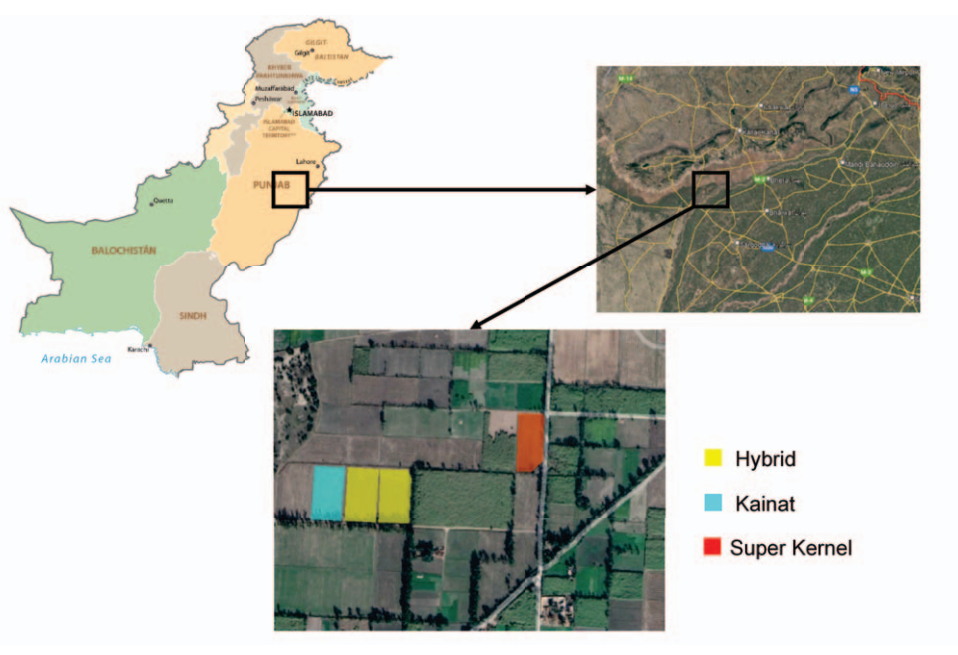
The rice crop holds great potential to contribute to the economy of most South Asian agricultural countries. However, due to global warming, changes in weather and climate have made it difficult for farmers to accurately predict the timing of various growth stages in the life cycle of rice. Deciding when to apply fertilizers to maximize yield and pesticides to avoid diseases becomes a challenge with conventional farming techniques. Hence, extracting key phenological metrics and analyzing the growth dynamics of different rice varieties are essential for this purpose. The foremost issue in this process is the lack of available multispectral drone imagery datasets, especially in South-East Asia. Therefore, a novel multispectral dataset of rice crops is presented that consists of three different varieties: Kainat, Hybrid, and Super Kernel in East Punjab, Pakistan. The study’s objective is to use this dataset to model a time series of Normalized Difference Vegetation Index (NDVI) and use the change detection method to map key phenological variables using the rate of change of NDVI. The analysis of available data using phenological metrics represents that the Kainat Basmati variant is growing faster than Hybrid as it reaches its peak about ten days earlier than Hybrid. Overall, our study demonstrates that remotely captured unmanned aerial vehicle (UAV) imagery of rice can streamline the process of predicting phenological metrics of rice and provide farmers with an automated statistical model of the growth stages of various crops.
@inproceedings{wasif2022sitis,
    title={Extraction of Rice Phenological Metrics Using Temporally Correlated Multispectral Drone Imagery},
    author={Wasif, Dawood and Khan, Muhammad Qasim and Ahmad, Malik Zeeshan and Murtaza, Ramesha and Zafar, Zuhair and Shahzad, Muhammad and Berns, Karsten and Fraz, Muhammad Moazam},
    booktitle={Proceedings of IEEE SITIS},
    year={2022},
    url={https://ieeexplore.ieee.org/abstract/document/10090062}
  }

Curriculum Vitae

Download Full CV (PDF)
Education
PhD in Computer Science
Virginia Polytechnic Institute and State University
Aug 2024 - May 2027 (expected) · GPA: 4.00/4.00
BS in Computer Science
National University of Sciences and Technology (NUST)
Aug 2019 - May 2023 · GPA: 3.81/4.00
Technical Skills
Languages
PythonJavaC/C++RustGoRScalaSQLTypeScript
ML / DL
PyTorchTensorFlowJAXHugging FaceTensorRTScikit-learn
LLM / AI
LangChainDSPyRLHFFAISSPineconeMLflowKnowledge Graphs
Cloud / Infra
AWSGCPAzureKubernetesDockerSparkRaySLURM
Experience
Graduate Research AssistantAug 2024 - Present
Trustworthy Cyberspace Lab (tClab), Virginia Tech , Arlington, VA
  • Designed human-in-the-loop RL coordination strategies for Connected Autonomous Vehicle defense, achieving over 25% efficiency gains in adversarial traffic simulations.
  • Collaborating with U.S. Army Research Laboratory on robust UAV/UGV teaming, improving resilience to sensor and communication perturbations by up to 80%.
  • Led research on privacy-fairness trade-offs in Federated Learning across various domains.
Research Scientist (Collaborator)Aug 2025 - Present
Crowdception Inc. , Washington, D.C.
  • Designed cross-platform XR clinical-intelligence stack achieving 95%+ object detection accuracy on Meta Quest and RayNeo.
  • Architected multi-agent biomedical LLM+VLM workflow for drug discovery on 10k+ compound-target pairs.
Machine Learning EngineerJul 2023 - Aug 2024
DCube Tech , Seattle, WA
  • Implemented scalable LLM inference optimization (quantization + LoRA), achieving 45% lower latency and 25% compute cost reduction.
  • Engineered spatiotemporal action detection on warehouse footage, cutting errors by 23% and saving ~$300K annually.
  • Designed multi-agent LLM architectures for enterprise automation, increasing workflow efficiency by 35%.
DAAD Research FellowJun - Dec 2022
Technical University of Munich (TUM) , Munich, Germany
  • Uncertainty quantification in remote sensing at the Chair of Data Science in Earth Observation under Prof. Xiaoxiang Zhu.

Academic Service

Conference Reviewer
  • NeurIPS2026
  • ICML2026
  • ICRA2026
  • IROS2026
  • ICDM2026
  • IEEE BigData2025
Awards & Honors
🎓
DAAD Research Fellowship
Technical University of Munich · 2022
🏆
Best Green Tech Hack
MakeUC Hackathon, IEEE @ University of Cincinnati · 2024
🏅
ICML Gold Reviewer
ICML 2026 · Gold Reviewer
🌟
3rd Place Overall & Crowd Favorite
DevRev AI Hackathon by Microsoft · 2022
Talks & Presentations
INVITED TALK
Human-in-the-Loop for Shared and Secure Autonomy
UxS and Data Technical Exchange Meeting, U.S. Army Research Laboratory, Adelphi, MD
January 22, 2026
RESEARCH TALK
RESFL: Uncertainty-Aware Responsible Federated Learning
ACM CAPWIC 2026, Virginia Tech IAC, Alexandria, VA
March 28, 2026
POSTER
Privacy-Fairness-Accuracy Trade-offs in Federated Learning
AAAI/ACM AIES 2025, IE University Tower, Madrid, Spain
October 22, 2025
RESEARCH TALK
Towards Trustworthy AVs: Semantic-Guided and Risk-Aware Learning
NSF AI Awareness Workshop 2025, Virginia Tech Research Center, Arlington, VA
September 17, 2025
Teaching
CS 2506
Computer Organization
Graduate TA , Virginia Tech
CS 5024
Ethics & Professionalism in CS
Graduate TA , Virginia Tech
CS 5614
Database Management Systems
Graduate TA , Virginia Tech
Summer Camps
Python, AI & ML Instruction
iD Tech , Amazon HQ, GMU, Marymount